Friday, April 22, 2011

A La Mode: Dunedin Art Gallery


I was recently in Dunedin and lucky enough to catch the exhibition advertised above,
A la Mode: Fashions of the Early Nineteenth Century. The framed hand-coloured etchings from Ackerman's Repository were exquisite, and I fell in love with this era of fashion, particularly with the decade from 1800 to 1810, with its "Classical forms", soft lines, and wonderful detailing.

Unfortunately I missed the presentation by Dress Historian Jane Malthus.

Rudolph Ackermann was best known for the periodical he started in 1809, The Repository of Arts, Literature, Commerce, Manufactures, Fashion and Politics. This monthly magazine, which lasted until 1828, included articles and illustrations of all sorts, especially on fashion, social and literary news. Fashion plates were included in every issue, and some also included patterns and fabric samples. The magazine became eagerly anticipated by society women and had a huge influence on the fashion of the day. By the end of its run, Ackermann had published almost 1,500 hand-colored plates in the Repository, and there is no better visual source as to the nature of Regency society than these wonderful prints.


Image photographed from Dunedin Art Gallery's, A La Mode, exhibition brochure. From Rudolph Ackerman's The Repository of Arts, Literature, Fashions, Manufacturers, &c. Hand-coloured etching on paper. Vol. 5, Feb. 1, 1811.

This was one of my favourite etchings, and I want this coat!!!! It is a carriage dress or travelling dress: a military coat or pelisse of amber coloured velvet, or merino cloth with Spanish cuffs, and high fluted collar, trimmed entirely round with Astracan fur. A round tippet of the same, and reticule composed of the same material as the coat. An Alerine helmet cap of the same, blended with Astracan fur, ornamented in front with an amber crescent and chain of silver. Gloves a pale tan colour and half boots of amber coloured kid.

I have no idea what Alerine refers to, if anyone can give me any idea I would be interested to find out. (I know I am such a geek). Astracan fur, could be a different spelling of Astrakhan fur, which comes from the Karakul sheep, an ancient breed, from Uzbekistan. The very young or even fetal lambs are prized for their pelts, dark in colour with tight coils of fur.


Image taken from Dunedin Art Gallery's, A La Mode, exhibition brochure. From Rudolph Ackerman's The Repository of Arts, Literature, Fashions, Manufacturers, &c. Hand-coloured etching on paper, Second series Vol IV, July 1, 1817.

Evening dress 1817. A plain white gauze dress, over a white satin slip.


Image photographed from Dunedin Art Gallery's, A La Mode, exhibition brochure. From Rudolph Ackerman's The Repository of Arts, Literature, Fashions, Manufacturers, &c. Hand-coloured etching on paper. Second series Vol. II, Nov. 1, 1816.

Morning Dress 1816
A morning dress was only worn at home, and only in the presence of one's family. I have to say, I wouldn't wear this hideous outfit out of the house either.

Image photographed from Dunedin Art Gallery's, A La Mode, exhibition brochure. From Rudolph Ackerman's The Repository of Arts, Literature, Fashions, Manufacturers, &c. Hand-coloured etching on paper. Second series Vol. VI, Nov. 1, 1825.

Garden Costume 1825
This dress fits into the walking or promenade gown classification. These were always the most fashionable, with beautiful trimmings, and worn during social times when out and about.


Image found on internet from Ackerman's Repository.


Image found on internet from Ackerman's Repository.


Image from Costume Calvacade, by Hansen.

473 - Turban, tunic over chemise gown with train, 1801. 474 and 475 are the same gown - Chemise gown with velvet train falling with sleeveless waistcoat, also 1801.

Well what do you think my precious darlings, do you love the carriage coat, or is it a flop with you. Now if only I could find some velvet in a beautiful yellow shade and something that resembled Astracan fur, I couldn't kill those poor little baby lambies, oh no not me.


Thursday, March 31, 2011

Beading and Radiotherapy


Recently I had four days of free time on my own, away from friends and family, with no responsibilities, not even to cook for myself. So my creative darlings in a situation like that, what does one do?

I took a little project away with me, and although it is not finished yet, this is the result. The first attempt with a new medium, beading. I had purchased some glass seed beads, that looked Victorian and was keen to have a play with them. Lesson learned if I am going to pursue this I need a tapestry frame, fabric needs be stretched when you are working on it.


It was intensely absorbing and I barely left my room for the whole four days.


I have mentioned Rafaella Serena's book in a previous post, and I was inspired by an image in her book.


It was a detail of a sampler from her book, embroidered in cross stitch, in silk thread on linen and worked in Italy the first half of the 19thC. It is from the collection of the Palazzo Danvanzati, in Florence. Put a link in for you if you would like to take a little trip to Florence, what an incredible museum.


Below are the front and back of a small purse worked in glass pearls, from a private collection in Milan, also taken from Raffaella's book.


The detail in this work is extraordinary, but then glass and beads were refined to some of the highest levels in this part of the world.

So there is probably at least 30 hours work in my feeble attempt at bead work at the head of this article, imagine the hours that went into this little purse. This was at a time when we were not just consumers as so many of us are today, but producers, and skilled artisans were highly valued. It was not about the cheapest, it was about the most beautiful, the highest quality. We have lost so much in the way we value things today. Clothes made from cotton that has sucked lakes dry, and pegged young Chinese girls eyelids open, so that we only need to spend $10.00 on a piece of clothing, that will shortly be thrown into a landfill, because it was actually rubbish when we bought it.

Monday, March 28, 2011

The Best Way Series No.16 Coat Completed


Hallo my precious darlings, it has been so long, and I have not been in touch. Other more pressing things have taken my time and I was torn away for a time. However I have still had needle and thread in hand, and here is some wonderful news, a completed project to show you.

A coat made from a pattern found in the collection of The Brain Watkins House in Tauranga. The pattern was adapted from the enclosed free pattern in a Best Way sewing magazine to the style of one of the illustrated coats in the magazine. It is from the early 1900's, and the finished coat stays true to the cut of the era.

Here it is in all its Autumnal glory.


I thought I would show you some of the inner workings of the coat, and here you can see the horse hair interfacing used on the lapels. This wonderful fabric is getting hard to find, it is the tailor's sculptural medium.


Worked with pad stitching as shown here, two layers of fabric can be made to hold form and shape. Its a wonderful thing.


Here is the collar, with completed pad stitching.


Pressing is as important as sewing in tailoring, and the tools of this trade, rounded pressing pads, baby muslin pressing cloths, and sleeve boards are indispensible.


And of course I have to show you the button, only one, but this was the biggest button in my collection. So there it is finished in time for the oncoming winter, and we know what that means don't we, I can buy some more fabric, or a pattern or .......... Tee Hee and Away!

If you want to follow the development of this coat here are the links in this blog to the posts.


Friday, February 25, 2011

A Seventeenth Century Embroidery


This is a Victorian era reduced copy of a seventeenth century curtain embroidered with crewels. So the scale has been reduced from the actual size of the original. It must have been a beautiful thing the curtain, don't you think. I imagine the thread colours were rich and earthy, aubergine purple, peacock blue, leaf green, Morrocan red, and mustard yellow.


This is a detail of the design showing some of the design inspiration for the thread work. Crewelwork is over a thousand years old, the Bayeux tapestry uses crewelwork techniques. It is worked in wool, with different embroidery stitches filling a design outline applied to the fabric.


Its a quite naturalistic style, and yet with lovely free flowing lines and layout, feels sort of Persian to me. What do you think?


French knots, satin stitch and couched threads, and built up layers giving a texturally rich surface.

So I love it, what a wonderful form of embroidery, and I want to have a play with it, but I am not sure about the woolen thread, I think I will play with a finer form to start with, maybe working with applique.

Wednesday, February 23, 2011

A wonderful book


I wanted to share a book with you that I purchased off Trade Me. Unfortunately I don't have a camera at the moment so I can't show you an image of it. However here is something beautiful in the same vein, a very old and fragile embroidery.


The book is Berlin Work Samplers and Embroidery of the Nineteenth Century, by Marina Carmignani.

I haven't been able to post for a few weeks as I have a few distractions at the present time. However I wanted to share something from the introduction of the book I mentioned above, written by Huguette Perol, Ambassador of France in Rome.

"When I think of embroidery I think of Penelope who weaves and then unweaves her loom, patiently absorbed in her work; a long solitary wait, a discreet unfolding upon itself, her hands that move lightly and quickly, busy in her pleasant work while her mind is free to fantasize or think. Domestic art for excellence, feminine art made of dreams and thoughts, next to an open window to catch the light or near a fire where the flames make colours dance."

I loved those words, they spoke to me so beautifully, as this is my favourite place to be, creative and working with a delightful textiles next to my garden window, or seated by the fire, a place of peace and tranquility.

Thursday, February 10, 2011

Do you remember Trixies' Coat


Well you may not have met the gorgeous Trixie, in the days of her youth she was a great star of the screen and stage.

She is the most wonderful, inspiring friend, and has so much love to give, she is vibrant and full of life. I love her dearly. So I wanted to make her a unique piece of clothing, and to me the Butterick coat pattern from 1919, said so much about the person she is.

You see she loves pleasure, and all things fine, as the Beau Epoch drew to a close, this coat encapsulates so much of what that era had been. The Japanese influence, that shaped the look of Art Nouveau, and introduced new shapes to gowns and coats, the feel of luxury reflected in this last age where the aristocracy, who lived their lives solely in the pursuit of pleasure, still led fashion.


Here is the toile, so you can see the shape of the coat. It is loosely cut, and beautifully shaped. Coats with this shape were known as cocoon coats.


Well it has not been in my thoughts for a while, and its time to start thinking about the embroidery, and decorative elements for the fabric of the body of the coat. These were some of the images that inspired me.


This pink was just divine.


And I wanted a Japanese feel.


I liked these simple circular shapes.


So often used in Japanese fabrics.


Still loving this, with the feeling of willows, from that wet spring day months ago, when we walked to the beach and talked about the coat.


So lets see what the weekend brings, and which project lures me in. What do you think of these colours, rather that the pink and green?

If you want to look back at the original post to see where I started, here is the link:

So you may be thinking


You are probably thinking this blog is all about ruffs, and that I have forgotten all about Trixie's and Jo Jo's coats. Well I haven't my petulant darlings, there is much more to come in those departments. It is just I have been pretty focused on an exhibition idea, but more to come on that later. Something else that has taken my time is the creation of a range of textile jewellery. I have been playing with some ideas, so tell me what you think?


This is called Hannah's ruff, I don't really know why. It is made with a fine cotton lace sewn onto a figured cotton voile, crisp and sheer.

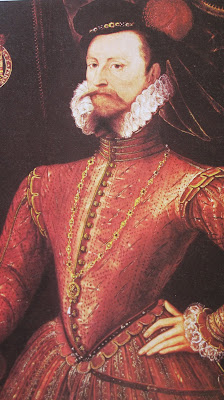
I was trying to get a ruff that looked like the one worn by Robert Dudley, Earl of Leicester, in this 16th C portrait. I really like the look of his wrist ruffs, aren't they gorgeous?

I followed the technique shown above from: A History of Fashion, by J. Anderson Black and Madge Garland.


So this is up to the first stage, before the pleats are joined as shown above. The pink taffeta looks gorgeous against the voile with its delicate floral print don't you think?

So I will be posting again soon, gotta start thinking about the coats again, get my mind off death and hospitals, needles and pain.