Showing posts with label The Brain Watkins House Collection. Show all posts

Thursday, July 21, 2011

The contents of a fabric covered box in the Brain Watkins House

 There are a number of boxes in the Brain Watkins House holding textile related items, the Cadbury Box with its hundreds of buttons that we have had a quick look at already, mahogany boxes, (one that appears to have been made for his daughter by Mr. Brain himself), and among them this one, containing a wonderful collection of buckles, from the Victorian era through to the 1960's.


The box with its contents when first opened.

 Here the contents of the box are laid out, ready to be catalogued.

 What does this box and its contents have to tell us?  Let us look through some of the items in this wonderful little archive of fashion history in Tauranga and see what we have.

 A Victorian buckle.

E.P.N.S. Electro plated nickel silver, known as nickel silver, became widely used after 1840 as a cheap substitute for silver.


The colour of the metal and the design of this buckle suggest it is of a similar era.


This brooch has diamantes in brass coloured mounts, set onto metal filigree work.  Stylistically it appears to be from the late 1800's to early 1900's.   Filigree work uses twisted metal wires shaped in curving patterns, soldered together at certain points creating an effect of lace.

On the reverse are 3 metal hooks where the metal brooch was attached to the garment.  The metal used in this brooch could be pinchbeck, an alloy of zinc and copper, used as a cheap imitation of gold.

Through the last two centuries there has been a love of the fashions of the 1700's, and this buckle with its portrait of an elegant women of that era is a reflection of that.

The powdered wig, and large straw hat with its floral trim and ribbons, are reminiscent of the Rococo period so popular in France at the time of Marie Antoinette.  Straw hats were fashionable as part of morning dress and this created a certain frustration for the fashionable lady of the day, who had a beautiful new straw hat, but knew it was unfashionable to rise before 11am.  What to do?  A fellow blogger Lauren has a great post on this on her blog: Marie Antoinette's Gossip Guide. 
http://marie-antoinettequeenoffrance.blogspot.com/2011/01/what-would-marie-do-hats.html


The reverse of the buckle.


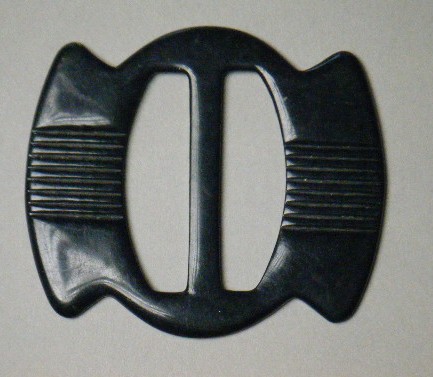
This buckle is made from an early lightweight plastic, possibly celluloid, and unfortunately it has broken in half.  I love the style and wonder what the dress it was originally worn with was like.  Possibly a slim fitting navy crepe dress with gold buttons, and a kick pleat at the back of the narrow calf length skirt.

This bakelite buckle is typical of those worn in the 1930's, and below the 1930 Sear's Catalogue shows the style of dress the buckle may have been worn with.


 I love the shape and form of this buckle, it is so Flash Gordon with it's Art Deco styling.
The 1936 film serial, that told the story of Flash Gordon and his team on a mission to stop the planet Mongo from colliding with earth, and his encounters with the evil Emperor Ming.
 
 One of the space ships, wonderful stuff.  They sounded like lawn mowers as they moved across the screen with the occasional glimpse of the wire holding them aloft.  Favourite Sunday morning television. But I digress.


 The Deco styling of this metal buckle is suggestive of the 1930's.


The crepe fabric this buckle is covered with has heavy staining, but it has an elegant shape.


A new hard plastic, this buckle is post 1940's.

The metal frame of this buckle is covered with white vinyl.

Although this belt was not in the box with the buckles, I had to include it to finish this post.  It is part of the Brain Watkins House collection, a thin red plastic belt from the 1970's.  Isn't it fantastic?  In this post I hope to have illustrated how fashion is not only influenced by the culture and events of the times, but also by new materials and ways of using those materials.

Tuesday, July 5, 2011

Embroidery on the 1919 Butterick Coat


Today I am working on the 1919 Butterick coat, yes I know this is such an old story we want something new.  It is a little frustrating as the embroidery is taking so long, and so it is difficult to find the time to write posts as well, and I miss you all so much my precious darlings.


 As I sit embroidering Falling Willow Blossom pattern on the black wool flannel of the back of the coat, my mind is free to wander.  It takes me back to an article I was reading at breakfast in the Listener, titled Crafty Calling, by Jane Clifton.  The article was commenting on crafts and a new annual craft venture called Handmade, started by Te Papa, which in June ran 159 workshops in food production, textiles and other artisan skills, which were no longer routinely passed down the generations.


The organiser Melanie Walker commented that the recession has probably had an impact on the resurgence in craft, but also: "people are reassessing their consumer habits and looking for more meaningful experiences than shopping for goods."  This along with green issues, not just throwing things away, but recycling were becoming more important to people.  It seemed the Handmade workshops were not gender exclusive, and that men and boys were taking up embroidery, and even exhibiting in this medium.  
Check out the work done by these young boys in this exhibition, No Rules, held at Auckland's Objectspace:  


 Here is a close up detail of the design.


It is interesting to me, as it seems I am not so odd after all, but part of a larger move, a paradigm shift in certain sectors of society.  Isn't it wonderful?  Maybe the margins between craft and art are beginning to blur, and the defining line of Public Art Galleries, the great commodifiers of art, that art is about ideas, the great mantra of Art Curators, is wearing a little thin, maybe they are starting to lose control of being able to say what is art and what is not and maybe we will no longer be able to say: that a stitch dams any work as craft, decorative, and of lesser value.


Monday, June 27, 2011

Crochet Buttons from the Brain Watkins

Do you remember these buttons from the Brain Watkins House?

Image courtesy Tauranga Historical Society

 With their delightful button moulds or molds.

Image courtesy Tauranga Historical Society

Well I am happy to say that I have found out a little more about these delightful buttons from a book titled: The Collector's Encyclopedia of Buttons, by Sally C. Luscomb.  An American book it does largely focus on American makers and buttons, but still a great source of information on buttons and the different materials they are made of.

The Collector's Encyclopedia of Buttons

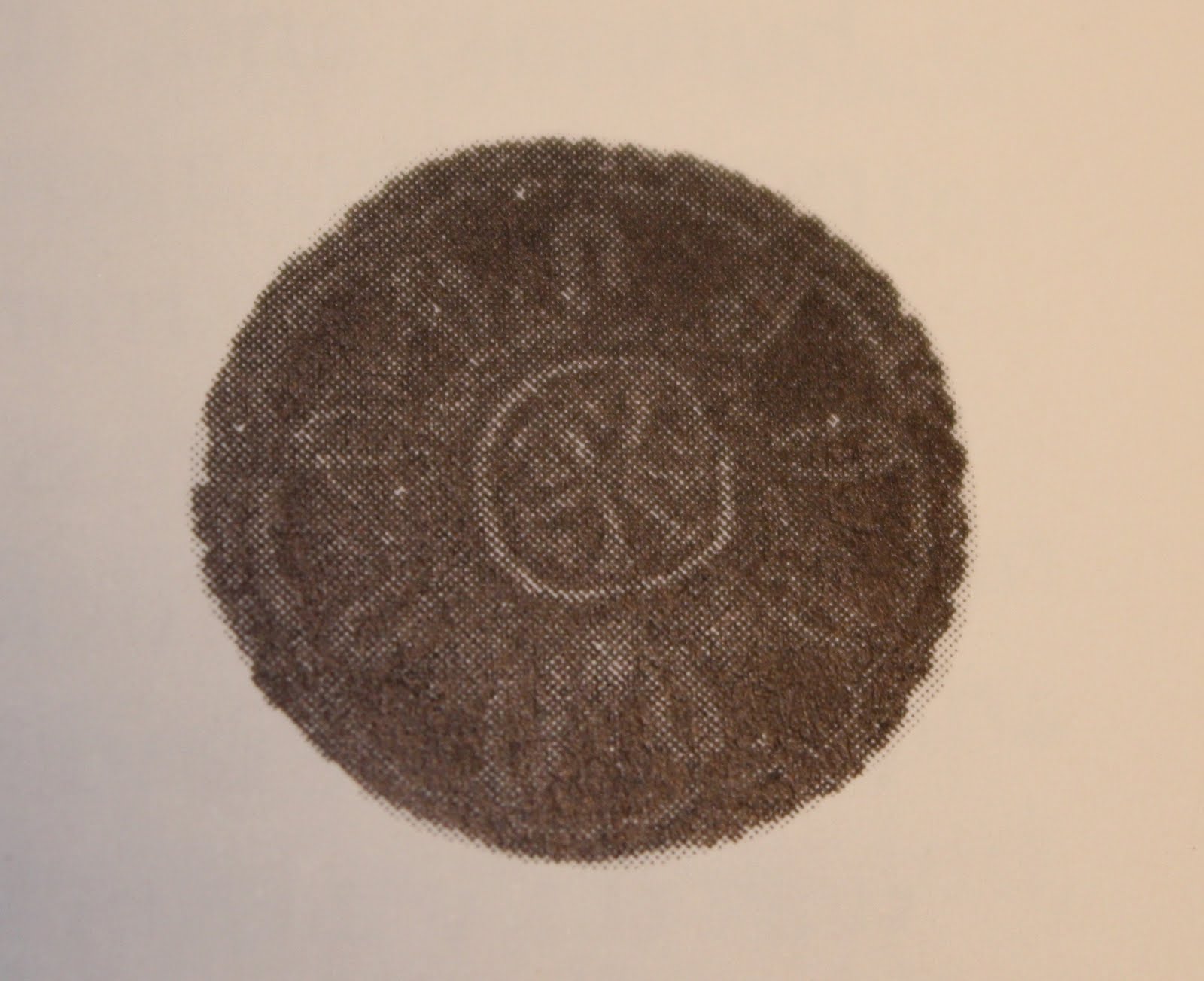
 This is an illustration from the book, unfortunately the quality is not very good, but if you look at the white   button in the middle of the top row, it is identical to the image above this one of the button in the 
Brain Watkins House.

The book states: "Crochet: A type of needlework made with a hook, sometimes used to cover buttons.  At first it was made by hand, later by machine.  "Caps" were crocheted, then placed over wooden molds that had first been covered with fine silk threads.  The caps were sewed on the back to hold them in place."  


Black crochet button from: The Collector's Encyclopedia of Buttons

"Black and white crocheted buttons are quite easily found today, but these buttons are also found in pastel and deeper colors.  Crocheted buttons first became fashionable in the 1880's.  Sometimes beads were put on the thread as the cap was being crocheted, the beads being the same color as the thread. 

Crocheted covered buttons again became popular in the early 1900's.  The caps of this period often were patterned and made of cotton and linen threads for women's cotton and linen dresses and suits.  These buttons are found with cardboard molds, or in the case of ball-shaped buttons, stuffed with cotton."

As the buttons in the collection of the Brain Watkins' have wooden moulds, this would suggest that the crochet buttons are from the 1880's.

Image courtesy Tauranga Historical Society
This is a piece of crochet from the Brain Watkins, it measures approximately 50mm across, and the wooden moulds found in the box are 30mm, this would make the crochet circle the right size for the moulds.  The crochet circles were found in a separate box, with a selection of similar crocheted pieces, and threads.

 Crochet buttons were made in Ireland and France, and the crochet pieces found in the house along with thread and fine crochet hooks, suggest that the Brain women may have made some of these buttons. 

Wednesday, June 1, 2011

The Rayon Blouse from The Brain Watkins House

All images courtesy of Tauranga Historical Society
Hallo my textile loving darlings, today I have a special treat from the Brain Watkins House, the sweet little blouse you see above.  I believe it to be from the 1930's, and made by a skilled seamstress.  In this post I am going to walk you through its construction.  I would love to recreate it myself, and it would be fun to work through it with a group of others interested in learning some sewing skills from days gone by.

  
First lets take a look at the fabric the blouse is made of.  I think it is a rayon fabric.  Rayon was the first man made fabric, but not a synthetic as it was  made from regenerated and purified cellulose derived from plant sources, from soft woods, or the short fibres (linters) that adhere to cotton seeds.  First patented in 1894 in England, the first commercially produced rayon appeared around 1910, and was called artificial silk, and was a cheap replacement for silk. The fabric later became known as viscose rayon.  

Rayon was the miracle fabric of the 1930's, its versatility of production, as a continuous filament yarn, or as short filaments that could be twisted and spun into a yarn, meant that it could be used to recreate almost any fabric.  Silk, satin, crepes, crepe de chine, velvet, boucle, garbardine: rayon could do almost anything. 

The link below will take you to Tuppence Ha'penny Vintage, a great blog that has so much information on rayon, it is really not worth me trying to repeat it.  If you want to know more it is all there, thanks Charlotte for a great post.


So my dear Watson, from all this, my deduction is that this blouse is made from a lightweight pale apricot rayon crepe.

From a museum perspective the acidic nature of cellulose means the rayon fabric like a cheap paper has a self destructive nature, and this along with the wear on the fabric from perspiration stains, is the cause of the dark staining seen under the arms, and the extensive foxing, (rust coloured spots).  These are a sign that the fabric is degenerating. 

So here is a complete description of the blouse, something you might see on a catalogue card or museum database.

Pale apricot pink rayon crepe blouse with short sleeves, and decorative smocking in triangular shapes on sleeves and both sides of the front of the blouse running from the shoulder seams.  


The shirt has a rounded collar, and front inset that have been worked in a technique similar to tape lace, but using tubes of the rayon, sewn by machine, in place of tape, and hand sewn with a twisted faggoting stitch and spider stitch. 


The collar is cut from a single layer of the rayon crepe fabric, 25mm wide, with rounded ends, and edged with the crepe tube lace, and machine sewn into the neck.  


This neck seam is finished like a French seam with a second row of machine stitching that forms a drawstring tube for the tube of fabric that forms the neck tie to run through, this is threaded through this seam and runs around the neck. The front opening closes at the throat with a bow which ties at the throat, and the lace panel around the opening has a rounded lower edge.  


The edge of the face fabric for this inset has first been finished with a running backstitch turning a 2mm wide raw edged seam, finished and held in place with the loops of the twisted faggot stitch as it has been worked into the front panel.  The work is finely and skilfully done, the stitches difficult to see with the naked eye.  


The smocking is worked with a twisted apricot/pink embroidery thread that has a glossy surface, this may be a rayon, silk or cotton thread.  


The hem of the blouse has an inset of 6mm wide white elastic, set in like a drawstring, with a 17mm wide turn-over of the rayon crepe that would have been gathered by the elastic forming a frill.  
The side seams are set 650mm from into the back of the blouse, rather than running down the true side seam.  The side seams, and sleeve seams are sewn by machine and are French seams.  The elastic is sewn in with two rows of machine stitching. 


The shoulder seams, and sleeve armhole seams are sewn by machine and finished with a running hand stitch.  


The sleeves are only gathered along 70mm at the top of the armhole, (35mm on each side of the shoulder seam), and are 190mm long from the top to the edge of the lower edge. 


The hem of the sleeve is bound with a bias cut strip of the rayon crepe, that has been sewn onto the right side of the sleeve, turned to form a 4mm wide tube, and hand sewn  with a diagonal running stitch on the inside edge.


This blouse is skilfully made, by a professional dressmaker or talented home sewer.  It demonstrates many embroidery and couture techniques.  The style and fabric suggest it was made in the 1930’s the Sear’s Catalogue was showing smocked blouses like this in its 1936 edition.  It was in the 1930's that Dunlop scientists were able to transform latex into reliable elastic thread, and elastic fabrics began to change the form of underwear and clothing.


A little treasure don't you think, and also a reference or archive of sewing techniques, that are being lost because we are not teaching our children to sew, and probably do not know how to sew ourselves any longer either.  

Finally I have to leave you with this link, please go and have a quick look, watch the video, start to think about your clothes and crafts in a different way.


Tuesday, May 31, 2011

Buttons from the Brain Watkins Collection


 I am not sure what this wooden box held when it was first purchased, chocolates in a wooden box seems a little unusual, the design on the front of the box has an Art Nouveau feel, and if so would date the box to late 1800's to early 1900's.  When I first saw it, there were 442 buttons in it.  

Would you like to see some my curious darlings?


Keeping in the theme of the wooden box, lets start with these, not buttons, but wooden moulds for buttons.  I wish you could get these today, cos I hate the covered button kits that are are available now, plastic and junky.  Imagine the buttons you could make with these wonderful wooden moulds.  The wonderful thing about the wooden chocolate box, is that its contents reveal the whole construction process of how these moulds were used, to make beautiful hand crafted buttons.


On the left is a mould with a round of padding over the top, and a layer of cream fabric over this, (ignore the 3 stitches you see on the mould as these were sewn by me to hold the mould onto the display panel it has been mounted on).


The covering fabric was placed over the padding, gathered at the back and sewn in place. 


This button looks like an early attempt.


This one by someone with a little more experience, and is a technique I have not seen before. 


This one is quite beautiful don't you think?


What would these buttons have been sewn onto, can you imagine the dress?  


And these little pink balls, which are not based on wooden moulds, but filled with a soft textile inner balls, are also made from a similar technique, aren't they the cutest things?  If anyone can help me with any information about this technique, it has got me stumped, and I would love to know what it was called and how it was done.