Tuesday, November 30, 2010

Hats from the 1700's

What was going on back in the 1700's?

The 1700's have long been my favorite fashion era, and I thought my precious darlings might enjoy a little look at some of the most lavish and decorative head gear ever worn.


Grey hair was quite the vogue.


J'avais une poof sur ma tete.


Its not too much is it?


Oh the sumptuous elegance of these wonderful hats. Do you love them, or are they just too much?

Saturday, November 27, 2010

Pippi the rag doll

I went out into the garden today, and who did I find there but Pipi.


She was relaxing in the sun, happy that she was finally finished, and quite keen to get to work selling socks for Margaret at the Cargo Shed.


Pippi called me over because she had a secret to tell me. She was very excited and happy because she had been told that Princess Isabella was coming to New Zealand in January. She was hoping that the Princess might come to the Cargo Shed and visit her there, or maybe she might get a day off to go and see the Princess.


As I walked towards her


She jumped up with excitement saying, I just can't wait.


So there she is all finished and wearing her crochet top and skirt specially designed for her by Margaret. Now all she needs is a pair of little woolen socks and she will be hard at work.

Friday, November 26, 2010

1950's Underthings

What was going on under there?


A kind friend who knew I was interested in the history of fashion and costume, gave me a collection of Seventeen magazines from the 1950's, that she had kept since her teenage years. Thank you Briar, they are real treasures and I would like to feature some images from them here. What a wonderful era of fashion the 50's were. Dior's New Look, and the end of WWII, drew women back to domesticity, femininity, and sexuality. The look drew its inspiration in many ways from the 1850-60's in the Victorian era, and women were encouraged to look demure and passive.


And those tiny waists, what was going on under there?


This Featherlight-4-in-1 Flex-o-lette has boning inserted in the seams, making it quite similar in construction to the corsets of the Victorian era.


You could even purchase crinoline type petticoats, made modern and young with a new name - Hoop-la.


And massive frilled petticoats to hold the skirt out further, to make the waist look even smaller.


New fabrics were being developed, and women were no longer prepared to suffer discomfort and lack of movement to fetish their waistline.


Rubber was first transformed into a textile fabric in the 1930's and the first fabrics were known as Lastex.


Don't you love this image, we always want to have it all don't we. So my precious darlings now you have a little insight into how the 1950's women achieved those tiny waists and pencil slim figures. Come back soon and I will show more of the wonderful dresses from the little collection of Seventeen magazines that I have. There are a couple I would love to sew for myself, I might put those up soon and you could tell me what you think. Kiss kiss my darlings until next time.

Wednesday, November 24, 2010

Seventeen Magazines Swimwear in the 1950's

Hallo my pale darlings, well summer is almost upon us and to put us in the mood I have some wonderful swimwear from the 1950's.


If you are still feeling all locked up by winter, well now its time to rock your way into summer.


I love this international number, yes darling this was what they were wearing in Paris that summer.


Wild things!


And of course there were hats for the seaside too.


And bags.


Have a great summer my lovelies.

Tuesday, November 23, 2010

More of the hats in The Brain-Watkins House

The Tale of Tam O Shanter

Hallo my hat loving darlings, here are some more wonderful hats from the Brain-Watkins House. This dreamy little blue felt hat is a Tam-o-Shanter, a Scottish hat originally only worn by men, that was adopted by women and became a popular fashion accessory.

Here is a tartan version in the Scottish style, this one comes with hair.

The name of the hat was inspired by a Scottish legend that was written as a poem by Robert Burns, the most famous of Scottish poets. Tam o Shanter was chased by witches on his way home from the pub, and only saved because his mare's tail came off in the hand of the young witch chasing him.


Here is another version in quilted cotton, with a jaunty little bow on the side.

And another of quilted blue satin.

Saturday, November 20, 2010

Elva's Bedroom: The Brain-Watkins' House

Hallo my historical darlings, let me show you another room in the wonderful little house known as, The Brain-Watkins'House. The Victorian Villa built in 1881, that still sits on Cameron Road in Tauranga. Come and see the bedroom, known as Elva's bedroom, because it is set up with many of her personal belongings. However it is believed that the room now known as the pink bedroom, was actually the room Elva slept in.


This wiew shows the remains of the fireplace, which has been boarded up, and now functions as a display area for some of the dresses in the collection.


It is also where a part of the hat collection is displayed.


The top of the dressing table houses a collection of personal artifacts. Look closely at this display, it has been set up as a display of the objects, it doesn't feel natural. No woman would lay her shoe horn, tablecloth duster, clothe's brush, and hand mirror in a line like that. My feeling is that this makes this dressing table look more like a museum display, rather than a group of personal objects in a private setting. Displays in historic houses look great when they give the impression the owner of the house has just walked away and left an area as she or he was using it. This can take a lot of careful research, to gain an understanding of the life, personal habits, and taste of a person, so that you start to unravel and understand their personalities. For me, as a social historian, this is when historic houses become really interesting.


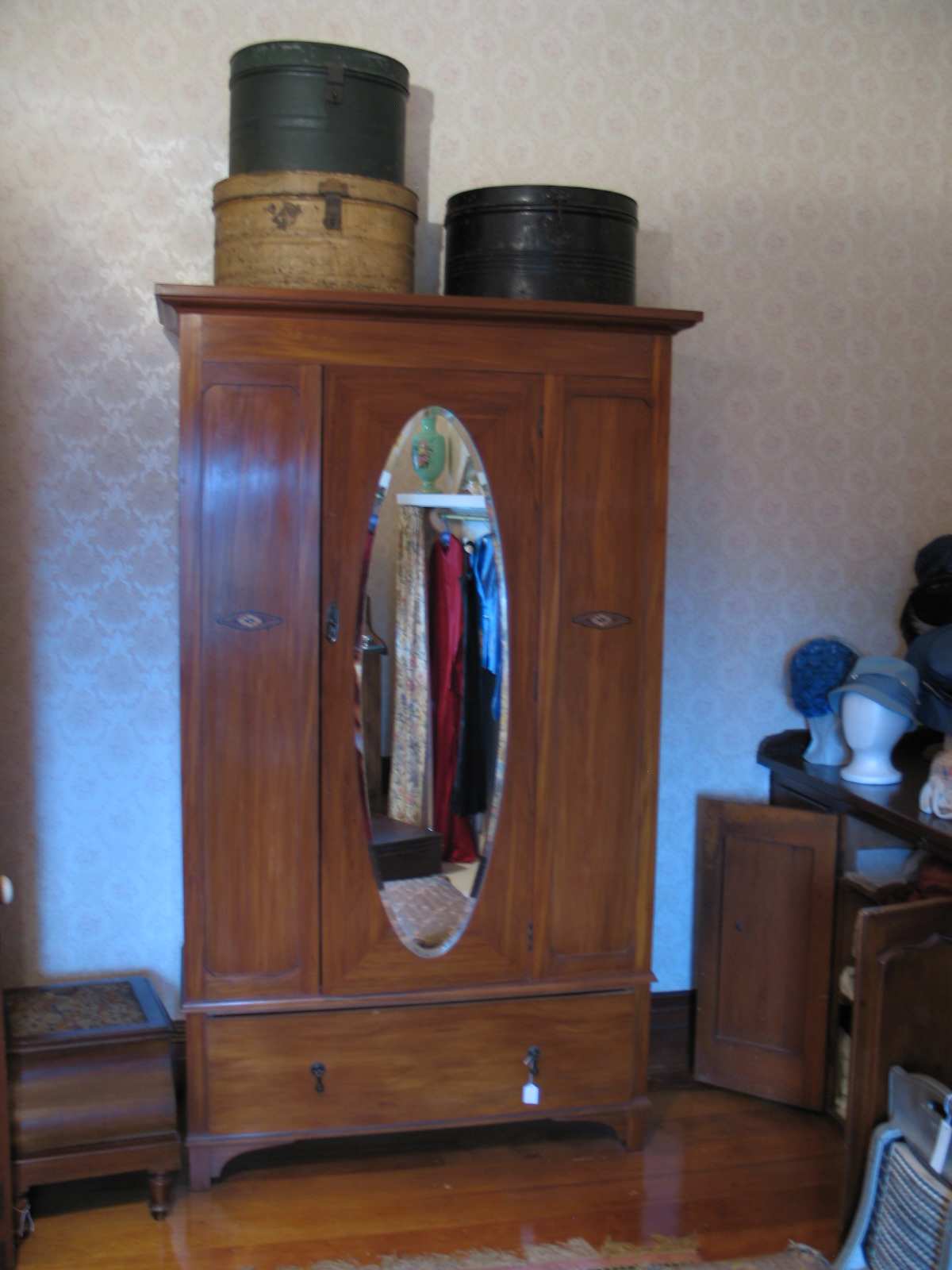
This beautiful stand-alone wardrobe, with its elegant oval beveled mirror, has a small group of hat cases stored on it. These metal cases were popular when train travel was the way of travelling from one end of the country to the other, and woman wore hats. The strong metal cases protected the hats when they were stowed in storage, when one went on a journey.

Tuesday, November 9, 2010

Engageantes for the mid nineteenth century dress

False sleeves, like the one below were worn in the nineteenth century, and were either pinned or sewn into the sleeves of bodices, so that they could be removed from the dress and washed, to protect the bodice or gown, which was more difficult to launder. Known as engageantes, they were the height of fashion in the mid 19th century.


Here is a false sleeve from the textile collection of The Elms Mission House and Library. It is made from a fine cotton lawn, and is completely hand sewn.


The pleats of the pleated frill of the sleeve have been basted to hold them in place.


This sleeve is also from the collection at The Elms. It has been edged with a delicate lace.


Here is the dress I am making for a display in the washroom of the servant's building at The Elms. I wanted to make false sleeves and a chemisette, so that visitors could see how these were worn and how they detached from the garment. Here is an image of the sleeve pinned in place.


What do you think?


I found a tiny little button from my collection for the cuff. I haven't quite finished them yet, but when I have, I will do a post about the making of these sleeves, I have patterns if anyone is interested.