Wednesday, November 24, 2010

Seventeen Magazines Swimwear in the 1950's

Hallo my pale darlings, well summer is almost upon us and to put us in the mood I have some wonderful swimwear from the 1950's.


If you are still feeling all locked up by winter, well now its time to rock your way into summer.


I love this international number, yes darling this was what they were wearing in Paris that summer.


Wild things!


And of course there were hats for the seaside too.


And bags.


Have a great summer my lovelies.

Tuesday, November 23, 2010

More of the hats in The Brain-Watkins House

The Tale of Tam O Shanter

Hallo my hat loving darlings, here are some more wonderful hats from the Brain-Watkins House. This dreamy little blue felt hat is a Tam-o-Shanter, a Scottish hat originally only worn by men, that was adopted by women and became a popular fashion accessory.

Here is a tartan version in the Scottish style, this one comes with hair.

The name of the hat was inspired by a Scottish legend that was written as a poem by Robert Burns, the most famous of Scottish poets. Tam o Shanter was chased by witches on his way home from the pub, and only saved because his mare's tail came off in the hand of the young witch chasing him.


Here is another version in quilted cotton, with a jaunty little bow on the side.

And another of quilted blue satin.

Saturday, November 20, 2010

Elva's Bedroom: The Brain-Watkins' House

Hallo my historical darlings, let me show you another room in the wonderful little house known as, The Brain-Watkins'House. The Victorian Villa built in 1881, that still sits on Cameron Road in Tauranga. Come and see the bedroom, known as Elva's bedroom, because it is set up with many of her personal belongings. However it is believed that the room now known as the pink bedroom, was actually the room Elva slept in.


This wiew shows the remains of the fireplace, which has been boarded up, and now functions as a display area for some of the dresses in the collection.


It is also where a part of the hat collection is displayed.


The top of the dressing table houses a collection of personal artifacts. Look closely at this display, it has been set up as a display of the objects, it doesn't feel natural. No woman would lay her shoe horn, tablecloth duster, clothe's brush, and hand mirror in a line like that. My feeling is that this makes this dressing table look more like a museum display, rather than a group of personal objects in a private setting. Displays in historic houses look great when they give the impression the owner of the house has just walked away and left an area as she or he was using it. This can take a lot of careful research, to gain an understanding of the life, personal habits, and taste of a person, so that you start to unravel and understand their personalities. For me, as a social historian, this is when historic houses become really interesting.


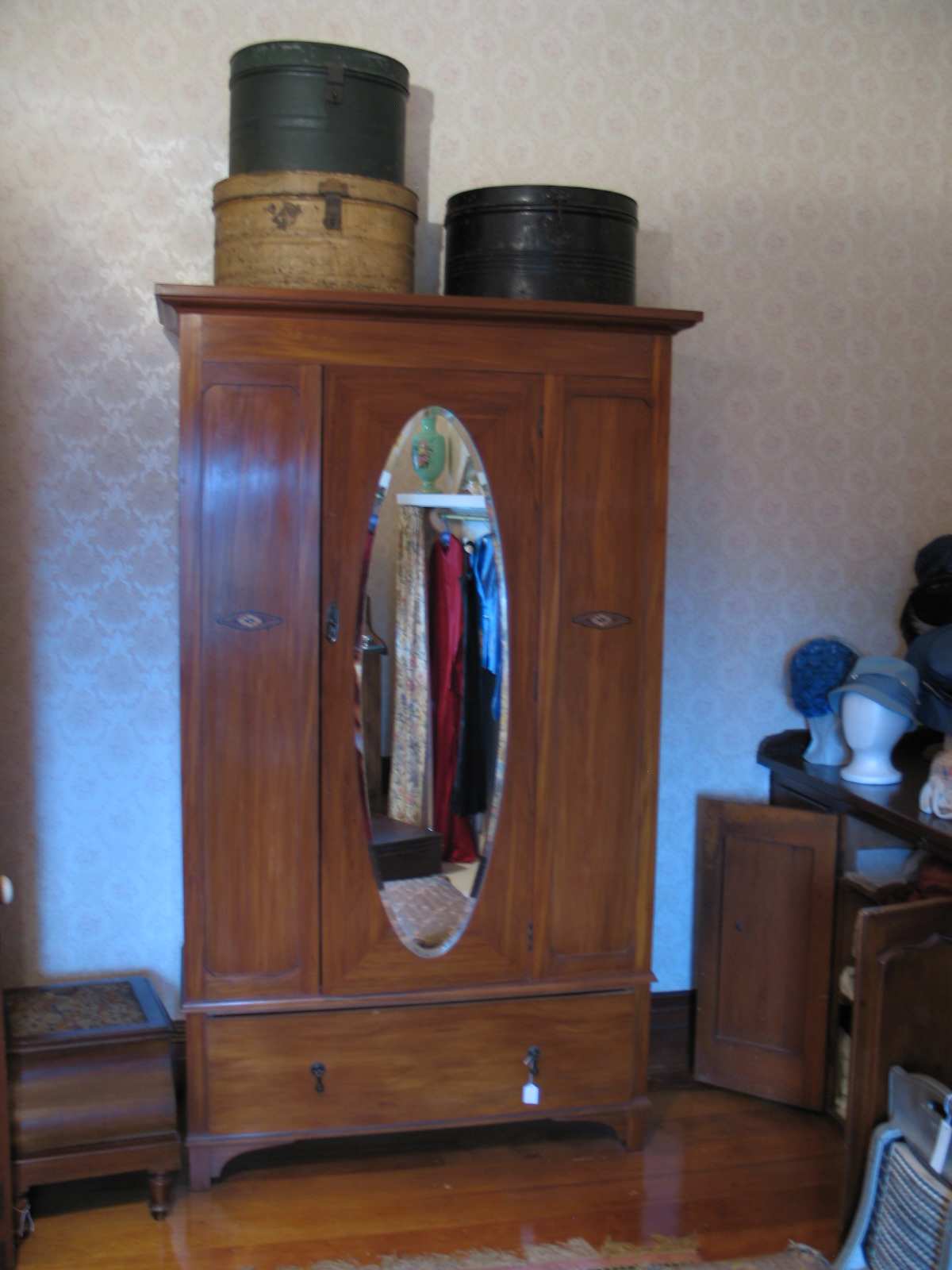
This beautiful stand-alone wardrobe, with its elegant oval beveled mirror, has a small group of hat cases stored on it. These metal cases were popular when train travel was the way of travelling from one end of the country to the other, and woman wore hats. The strong metal cases protected the hats when they were stowed in storage, when one went on a journey.

Tuesday, November 9, 2010

Engageantes for the mid nineteenth century dress

False sleeves, like the one below were worn in the nineteenth century, and were either pinned or sewn into the sleeves of bodices, so that they could be removed from the dress and washed, to protect the bodice or gown, which was more difficult to launder. Known as engageantes, they were the height of fashion in the mid 19th century.


Here is a false sleeve from the textile collection of The Elms Mission House and Library. It is made from a fine cotton lawn, and is completely hand sewn.


The pleats of the pleated frill of the sleeve have been basted to hold them in place.


This sleeve is also from the collection at The Elms. It has been edged with a delicate lace.


Here is the dress I am making for a display in the washroom of the servant's building at The Elms. I wanted to make false sleeves and a chemisette, so that visitors could see how these were worn and how they detached from the garment. Here is an image of the sleeve pinned in place.


What do you think?


I found a tiny little button from my collection for the cuff. I haven't quite finished them yet, but when I have, I will do a post about the making of these sleeves, I have patterns if anyone is interested.

Sunday, November 7, 2010

The W.H. Wyman 18th C Lawn Shirt


Pinned to this label were 3 children's garments, (you can see the pinholes in the paper), a linen shirt, a lawn shirt and a knitted shirt . The label is hand-drawn and the coloured letters painted by hand. It dates the 3 garments to 1702.


This is the lawn shirt, and it is 41cm from one sleeve end to the other, and 23cm long. It is for a younger child than the linen shirt I have previously blogged about, which measured 49 x 33cm. The lawn fabric is also softer than the linen, with a smooth hand almost like satin. It is a delicate, finely woven plain weave cotton. The shirt would fit a 6 month to one year old child.

The shoulder has a strip of insertion lace, edged with edging lace on each side. The insertion lace is so fine I cannot see how it is made. I was about to take some macro photos so that I could get a closer look at it, and my battery went flat. Damn that battery.


This is the best image I could get, I will have to blog about the lace in another post. This shirt is finer than anything I have ever seen, the skill of the woman who worked it, and the fineness of the tools she must have used, surpasses anything I have encountered in the heritage collections I have worked with. It is a treasure of great importance.


The shirt is completely hand-sewn and is so finely done, it is difficult to make out the individual stitches without the aid of a magnifying glass. The stitches running around the edge of the neckline are less than 1 mm long. I am not sure at this stage, but the lace around the neck edge appears to be hand made bobbin lace.


I love this little gusset under the sleeve, this shirt is made with similar techniques to an 18th century countryman's smock.


This image shows the seams, and hems of the sleeve. The photo does not do this shirt justice as their is no scale rule to show how tiny these stitches are. I will have to do another post with better photos, so enjoy what I have posted and look forward to more to come

Tuesday, November 2, 2010

18th C. Child's Shirt from Wyman Collection


A child's shirt

Firstly I would like to apologise for this photo. It has no scale or visual reference to its size. So let me explain, this shirt would have been for a very small child, perhaps the size of a one or two year old today. It is 33cm from the top of the shoulder to the bottom of the hem, and 49 cm form one end of the sleeve to the other. When I first received this shirt, from the descendant of Mrs. W.H. Wyman, it was sewn together with 2 other garments, to a paper label which read: "Hand-made lawn shirts, and knitted shirt - 1702. Exhibited by Mrs. W.H. Wyman. Olvondale or Orondale S.." I could not quite make out the spelling, does any of the family know which it is? Unfortunately the label does not state when or where the items were exhibited, but the family may know when Mrs. Wyman lived at Olvondale.

The shirt had been stored for many years sewn to the label, and has some heavy creases in it, and this would be the first time for many a time, that it would have been seen lying flat like this.

The label states that the two shirts are lawn, but I have my doubts about that. The fabric this shirt is made from has a rough hand, that feels more like linen than cotton. It may be a very worn, fine linen, that has the weight of a cotton lawn.

The shirt is very finely sewn, completely by hand. The shirt pattern pieces are rectangles, cut like an English countryman's smock, or a Japanese kimono, from a length of fabric without any waste. This was a time when fabric was valuable, and often still woven on hand looms.

Both sleeves are delicately pleated, with the pleats sewn in place on both the armhole and the narrow cuff. I want to make a shirt for myself with sleeves like this, I think it would be wonderful. The cuff has two buttonholes, rather than a button and buttonhole. Do any of my academic darlings know how this cuff would have been fastened?

The shirt is skillfully made, there are no raw edges, all the seams are finished beautifully. The collar is a single layer of fabric, illustrating to us again, that his shirt was made in a time when fabric was extremely valuable and expensive.


Did you notice the leaf green top stitching around the neckline and cuffs? At first I thought it was a simple row of running stitches. However as I looked more closely, I saw it was a couched thread. This garment is sewn differently to anything I have seen before, it is an absolute delight, and I think it is possible that it could be dated to the early 1700's.

The Underside of the Shirt


Sunday, October 31, 2010

The Bathroom of The Brain Watkins House

Hidden away at the back of the house, is the cutest little bathroom.


Look at that wonderful little bathtub, how cute is that?